
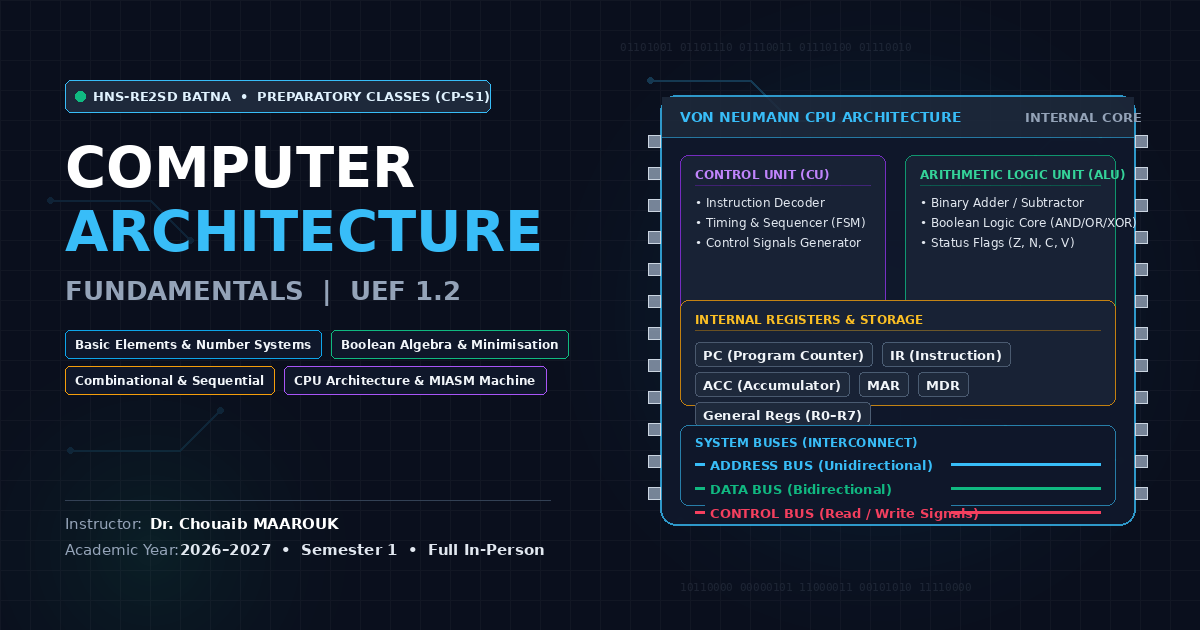
Computer Architecture: Fundamentals (UEF 1.2)
Preparatory Classes Department of Mathematics and Computer Science (CP-S1)
Academic Year 2026–2027 | Instructor: Dr. Chouaib MAAROUK
Course Overview
This foundational course provides first-year engineering students with a comprehensive understanding of the fundamental principles of computer hardware and digital system design. Students explore the progression from mathematical abstractions (Boolean algebra, logic minimization) to practical hardware implementation (combinational and synchronous sequential logic) and computer organization, culminating in low-level assembly programming on the MIASM educational machine.
Course Content (7 Core Units)
-
Basic Elements: Binary representation, base conversions, signed binary numbers, complements, IEEE 754 floating-point, binary codes (BCD, Excess-3).
-
Boolean Algebra & Logic Gates: Axiomatic definitions, Huntington’s postulates, basic theorems, Boolean functions, and canonical/standard forms (SOP, POS).
-
Gate-Level Minimisation: Algebraic and Karnaugh map methods (up to 5 variables), POS simplification, NAND/NOR universal implementations, XOR logic.
-
Combinational Logic: Circuit design procedures, binary adders/subtractors, magnitude comparators, decoders, encoders, multiplexers, and demultiplexers.
-
Synchronous Sequential Logic: Flip-flops (SR, JK, D, T), analysis of clocked sequential circuits, counters, and registers.
-
Computers Architecture: Basic computer organization, Central Unit (ALU, Control Unit), Central Memory, instruction processing, and addressing modes.
-
Study of a Pedagogical Machine (MIASM): Architecture, instruction set, addressing modes, and low-level assembly programming.
Administrative & Grading Policy
-
Teaching Mode: Full In-Person / Présentiel (Lectures: 42h | Tutorials : 21h | Coefficient: 4 | Credits: 5 ECTS)
-
Assessment: 40% Continuous Assessment + 60% Final Examination
- Teacher: CHOUAIB MAAROUK
- Teacher: HADJ ABDELHAK
- Teacher: Selma MAMMERI
- Teacher: Samia Allaoui
- Teacher: Anfal Lebbal
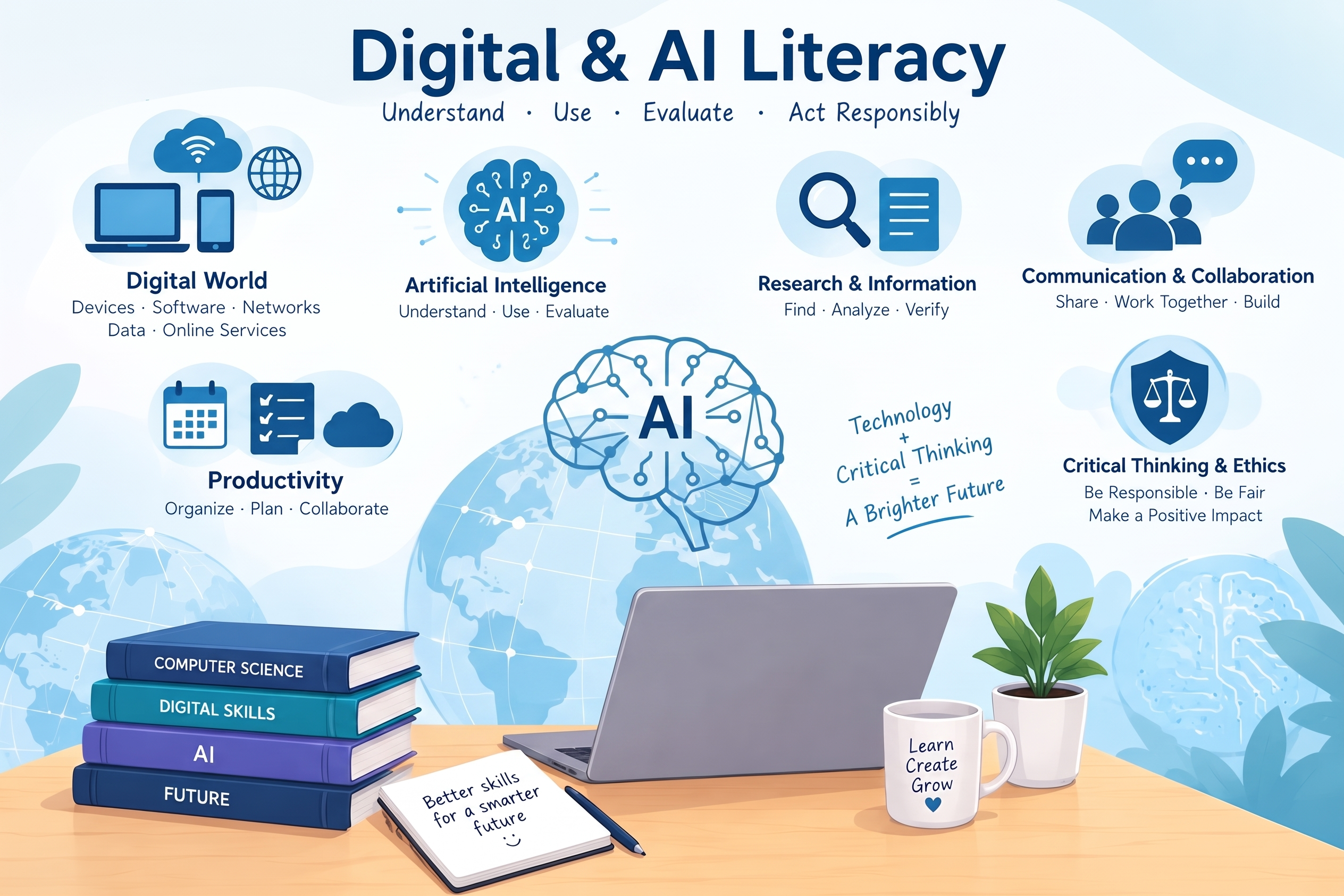
This course equips students with essential Digital & AI (Artificial Intelligence) Literacy skills for academic to effectively and safely achieve various goals in the digital world. AI literacy is critical in empowering students to engage with digital & AI era responsibly and ethically. AI literacy encompasses not great technical statistics of AI standards and algorithms but moreover essential thinking, moral concerns, and societal implications of AI era. Students will master advanced online techniques, improve academic performance, cultivate digital competencies, and develop ethical digital & AI practices.
- Teacher: Selma MAMMERI